

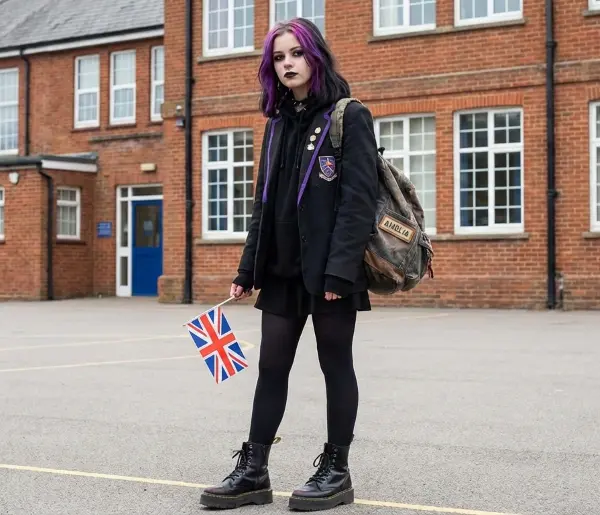
An AI-generated character named “Amelia” has rapidly gained attention across social media platforms, becoming a controversial viral figure linked to far-right online communities.
Amelia is presented as a fictional British schoolgirl, often shown with purple hair and gothic styling, appearing in short AI-generated videos and images. These posts typically show her walking through well-known London locations such as Parliament or busy streets while delivering nationalist and anti-immigration messages.
Although many users may not yet recognise the character, Amelia’s presence is growing quickly on platforms such as X (formerly Twitter) and Facebook, where memes and videos featuring her are being widely shared.
How Amelia’s Content Spread Online
Most Amelia content is created using AI image and video tools, allowing users to easily generate new scenes, styles, and narratives. Variations include animated, cartoon-style, manga-inspired, and hyper-realistic versions of the character.
In many videos, Amelia is shown expressing strong political opinions, often focused on immigration, religion, or national identity. These messages closely mirror common themes found in far-right online spaces, but the AI-generated format has helped them spread more rapidly and widely.
Because Amelia is fictional, creators can easily adapt her to different scenarios, making the content highly shareable and difficult to trace back to a single source.
The Unexpected Origins of the Character
Ironically, the Amelia character originated from a government-funded educational project designed to counter extremism.
An early version of Amelia appeared in Pathways: Navigating the Internet and Extremism, an interactive digital game developed for young people aged 13 to 18. The project was supported by the UK Home Office and aimed to help students recognise and avoid online radicalisation.
In the game, players make choices about online behaviour, including whether to engage with extremist content or attend fictional political events. Some scenarios were designed to reflect how real-world radicalisation pathways develop.
However, the character has since been repurposed and reinterpreted online, far beyond the original educational context.
Rapid Growth and International Reach
Researchers monitoring online disinformation say Amelia memes began gaining traction in early January, initially within small far-right networks. Within days, usage increased dramatically, spreading to international audiences.
Data from online monitoring groups suggests:
-
Early posts received hundreds of thousands of views
-
Daily meme creation jumped from hundreds to thousands per day
-
Content has now spread beyond the UK, appearing in multiple languages
The trend has expanded beyond political memes, with Amelia appearing in satirical crossovers, pop-culture edits, and AI-generated “interactions” with fictional characters.
Monetisation and Online Risks
In a further twist, online users have attempted to monetise the trend, launching a cryptocurrency token linked to the Amelia name. Analysts say this reflects a growing pattern where viral political content is used for financial gain.
Experts warn that this represents the commercialisation of extremist narratives, where shock value and controversy are used to drive engagement, clicks, and profits.
Organisations connected to the original educational project have reported harassment and threats, highlighting the real-world risks faced by those working in counter-extremism and media literacy.
Expert Concerns About AI and Extremism
Digital safety experts say the Amelia trend highlights broader concerns about AI-generated content:
-
AI tools make it easier to spread political misinformation
-
Fictional characters can evade moderation more easily than real people
-
Sexualised or stylised imagery can attract younger audiences
-
Memes blur the line between satire, provocation, and propaganda
Analysts note that the content primarily targets young male users, a demographic already vulnerable to online radicalisation.
Government and Platform Response
The Home Office has stated that its Prevent programme has helped redirect thousands of individuals away from violent ideologies and that educational projects are developed independently by specialist organisations.
However, the rise of AI-driven political memes has renewed calls for:
-
Stronger platform moderation
-
Improved AI content transparency
-
Expanded digital literacy education
-
Clearer safeguards around AI misuse
Why This Matters
The emergence of Amelia shows how artificial intelligence is reshaping online political discourse. A character originally created for education has been transformed into a viral symbol used for divisive messaging, demonstrating how quickly AI content can be repurposed and amplified.
As AI tools become more accessible, experts warn that similar trends are likely to increase, making media literacy and responsible AI use more important than ever.

