

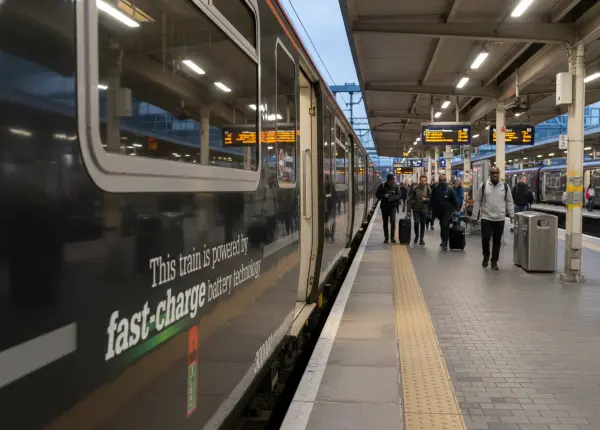
The UK is set to make rail history this weekend as the country’s first fully battery-powered train with rapid-charging technology enters passenger service for the first time.
Great Western Railway (GWR) will operate the new train on the West Ealing to Greenford branch line in west London, starting early Saturday morning. The service will run the full daily timetable, covering a five-mile round trip with four stops and a journey time of around 12 minutes each way.
How the Battery Train Works
Unlike traditional electric or diesel trains, this service runs entirely on battery power. The train recharges at West Ealing station in just three and a half minutes between journeys.
Charging is delivered through a high-power 2,000-kilowatt system connected to a short section of rail. This rail only becomes live when the train is positioned directly above it, improving safety and energy efficiency.
The train can carry up to 273 passengers, making it suitable for regular commuter use rather than just a technical demonstration.
A World-Record-Holding Train
The battery train has already proven its capabilities during testing. In 2025, it set a world record for the longest distance travelled by a battery-electric train, covering more than 200 miles on a single charge. This surpassed a previous record set in Germany in 2021.
Although the technology has been tested on the route since early 2024, this weekend marks the first time paying passengers will be carried.
Why This Matters for UK Rail
The project is seen as a major step toward reducing diesel use on the rail network. Many UK rail lines are not electrified because installing overhead power lines can be expensive, disruptive, or impractical.
Battery-only trains could offer a cleaner alternative on these routes, supporting the government’s long-term goal of decarbonising transport and reaching net-zero emissions by 2050.
GWR has said the technology could eventually allow it to replace diesel trains on longer routes in south-west England, where electrification projects were scaled back due to cost overruns.
Industry Leaders Welcome the Milestone
GWR’s engineering director said the launch shows that modern battery technology can provide a reliable and efficient solution where traditional electrification is not suitable. He added that the trial comes at a crucial time as operators look to replace ageing diesel fleets.
Network Rail, which installed the charging infrastructure, said the project demonstrates how battery trains can play an important role in building a low-emission railway. Officials described the service launch as a key milestone for the future of UK rail.
How It Compares Globally
Battery-electric and hybrid trains are already in use in countries such as Japan. In the UK, Merseyrail operates trains that can briefly run on battery power, but they mainly rely on a third-rail system.
What makes the GWR project different is that the train runs only on batteries, without overhead wires or a third rail. This approach is considered safer for the public and places less strain on local electricity networks.
What Happens Next?
If the passenger service proves successful, the technology could be expanded to other routes across the UK. Rail experts believe battery-only trains could become a key part of future transport planning, particularly on regional and rural lines.
For now, the West London route will act as a live test case, showing whether fast-charging battery trains can operate reliably in everyday service.

