

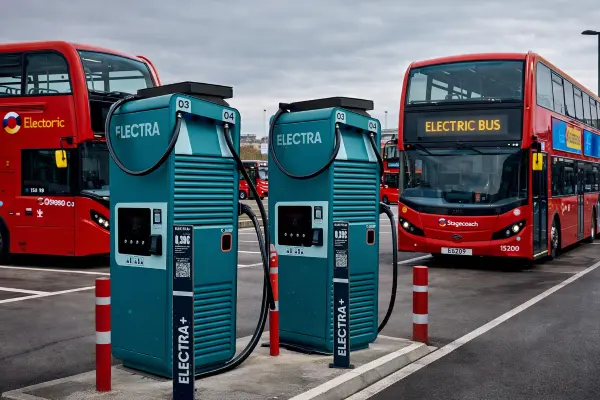
Five London bus depots have received significant electrical grid upgrades as part of a nationwide programme to accelerate the transition to zero-emission public transport. The work, carried out by independent grid operator Aurora Utilities on behalf of Stagecoach Group, has already energised sites at Ash Grove, Barking, Bow, Bromley and Leyton — bringing hundreds of electric bus charging points closer to operational readiness across the capital.
The programme is one of the most ambitious depot electrification efforts underway in the UK bus sector, and its London component sits directly within Transport for London’s target to run all London public transport on renewable energy by 2030.
What Has Actually Been Upgraded?
The work involves upgrading the electrical grid connections at bus depots so they can support high-capacity EV charging infrastructure at scale. This is not a straightforward task. Running dozens or hundreds of electric buses simultaneously — each requiring overnight charging or top-up charging between routes — demands a level of electrical capacity that most bus depots were simply not built to handle.
Aurora Utilities, which holds an Ofgem licence obtained in 2024 and operates as an independent distribution network operator (IDNO), specialises in exactly this kind of infrastructure work. Rather than bus operators having to navigate lengthy and complex negotiations with major grid operators, Aurora takes on the new grid connections itself — adopting, building and operating the electrical infrastructure needed to power charging systems at each site.
Across the full programme, 17 Stagecoach depots are now live with upgraded connections. Beyond the five London sites, the nationwide rollout includes depots at Aldershot, Arbroath, Ardrossan, Barnstaple, Cheltenham, Dover, Dundee, Exeter, Gloucester, Kilmarnock, St Andrews and Torquay — spanning operations from the south coast of England to Scotland.
The Scale: 1,330 Electric Buses and Counting
The numbers behind this programme give a clear sense of its significance. Aurora’s grid upgrades across the Stagecoach network are designed to support capacity for approximately 1,330 new electric buses — representing more than 16% of Stagecoach’s entire UK fleet.
To put that in context, Stagecoach is one of the UK’s largest bus and coach operators, running thousands of services daily across England, Scotland and Wales. Electrifying more than one in six of those vehicles requires not just the buses themselves but the infrastructure to charge them efficiently, reliably and at the right times to keep services running.
The programme is also expected to deliver significant environmental benefits. Aurora estimates the upgrades will enable cuts of tens of thousands of tonnes of carbon emissions each year — a meaningful contribution to the UK’s transport decarbonisation goals at a time when road transport remains one of the largest sources of national greenhouse gas emissions.
Why This Matters Specifically for London
The London dimension of this programme has particular importance because of the targets the capital has already committed to.
Transport for London has set an ambition to have its entire bus fleet running on zero-emission vehicles by 2030 — a target that, if achieved with government support, would save an estimated 5.5 million tonnes of carbon over the following two decades. As of mid-2025, London had already passed 2,000 zero-emission buses in active service — the largest zero-emission bus fleet in Western Europe — with over 107 bus routes now fully electrified.
But getting from 2,000 to the full fleet of approximately 9,000 buses requires a massive parallel investment in depot charging infrastructure. Every electric bus that replaces a diesel one needs somewhere to charge — and every depot that currently houses diesel buses needs to be upgraded before it can support electric operations at scale.
The grid connections now in place at Ash Grove, Barking, Bow, Bromley and Leyton represent exactly that kind of enabling infrastructure. They are not the buses themselves — they are what makes it possible to deploy the buses in the first place.
Stagecoach is also going further than just grid connections at these sites. The company is investing in battery storage systems and on-site solar generation at its depots — a combination that reduces dependence on drawing power from the national grid at peak times, improves energy cost efficiency, and strengthens resilience against supply disruptions.
What Is an IDNO and Why Does It Matter?
Independent distribution network operators — IDNOs — are licensed electricity distribution companies that operate alongside the major regional network operators. Aurora’s role in this programme highlights why the IDNO model has become increasingly important for large-scale infrastructure projects.
Traditional grid connection processes through major network operators can be slow and expensive — particularly for high-capacity industrial connections of the kind needed for bus depot electrification. IDNOs like Aurora can move more quickly, take on the connection assets directly, and operate them on an ongoing basis, which gives transport operators like Stagecoach both faster results and a clearer long-term infrastructure arrangement.
Aurora was licensed by Ofgem in 2024 and has received a $200 million investment from I Squared Capital — the same infrastructure investment platform that in 2024 acquired Arriva Group, one of Aurora’s key clients in the transport sector. That financial backing gives Aurora the capacity to take on large, complex programmes of the kind involved in the Stagecoach partnership.
London’s Wider Push for Cleaner Streets
The Stagecoach depot upgrades are part of a broader transformation taking place across London’s transport network, as the city works toward its ambition of becoming a net-zero carbon city by 2030.
Transport for London stopped ordering new diesel or hybrid buses in 2020. Since 2021, every new bus entering the London fleet has been required to be zero-emission. The capital now has more zero-emission buses in service than any city in Western Europe outside Moscow, and the pace of rollout continues to accelerate with each year of infrastructure investment.
The upgrade of bus depot grid connections — the less visible but absolutely essential foundation of the electric bus transition — is one of the key challenges that needs to be solved at scale before the 2030 target becomes achievable. Programmes like the Aurora and Stagecoach partnership are directly addressing that challenge.
Alongside the bus fleet transition, TfL is also investing in improvements to the wider road environment. As part of its broader road safety and sustainability strategy, TfL has been rolling out new radar speed cameras across London — part of the same long-term effort to make London’s streets safer, cleaner and more efficient for all users, including the growing number of zero-emission buses sharing those roads.
What This Means for London Bus Passengers
For most daily bus users, the transition to electric buses is already visible — quieter vehicles, smoother acceleration, and the absence of diesel fumes at bus stops. As more depots complete their electrical upgrades and more electric buses enter service, those improvements will become the standard experience rather than the exception on London routes.
Electric buses also tend to have lower whole-life operating costs than diesel equivalents, which over time supports the financial sustainability of bus services — a consideration that matters for the long-term reliability of London’s network, particularly on routes serving lower-income communities that depend heavily on buses.
The five London depots now energised — Ash Grove in Hackney, Barking in east London, Bow in Tower Hamlets, Bromley in south-east London, and Leyton in Waltham Forest — together serve a wide geographic spread of the capital’s bus network. Their electrification supports routes across east, south-east and north-east London, bringing zero-emission operations closer to some of the city’s most densely used corridors.
Key Facts: Stagecoach and Aurora Depot Electrification Programme
| Detail | Information |
|---|---|
| London depots upgraded | Ash Grove, Barking, Bow, Bromley, Leyton |
| Total UK depots now live | 17 sites |
| Electric bus capacity enabled | ~1,330 buses (16%+ of Stagecoach UK fleet) |
| Annual carbon saving | Tens of thousands of tonnes |
| Grid operator | Aurora Utilities (IDNO, Ofgem licensed 2024) |
| Additional investment | Battery storage + on-site solar at depots |
| TfL 2030 target | 100% zero-emission London bus fleet |
| Current London ZE fleet | Over 2,000 buses (largest in Western Europe) |
What Happens Next
Aurora and Stagecoach have not confirmed a specific completion timeline for the full programme, but the pace of deployment — with 17 depots already live — indicates the partnership is moving at scale. Further depot connections across the Stagecoach network are expected as the programme continues.
For Transport for London’s 2030 target to be achievable, the rate of depot electrification across all London bus operators — not just Stagecoach — will need to continue accelerating. The Aurora programme represents one important component of that, but it sits alongside similar work being carried out by other operators including Go-Ahead London, Arriva and RATP Dev, all of whom are progressing their own depot electrification programmes across the capital.
The transition to a fully zero-emission London bus fleet is a long-term infrastructure project measured in years, not months. But each depot that completes its electrical upgrade represents a real and irreversible step forward — one that makes it practically possible to put more clean, quiet, zero-emission buses on London’s streets.

