

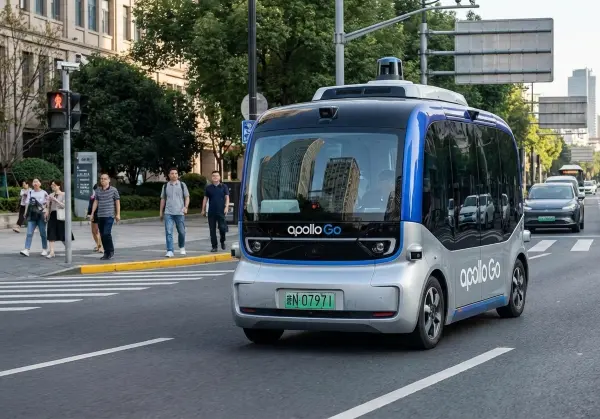
Uber and Lyft are preparing to test Chinese robotaxis in London, marking a major step forward for autonomous transport in the UK. Both ride-hailing companies have partnered with Chinese technology firm Baidu to launch pilot robotaxi programmes once regulatory approvals are in place.
The move comes shortly after Waymo, the self-driving car company owned by Google’s parent firm Alphabet, began supervised testing in the capital. Together, these developments signal that London is becoming a key testing ground for the future of autonomous mobility.
Uber to Begin Testing Baidu’s Apollo Go Vehicles
Uber is expected to start testing Baidu’s Apollo Go robotaxis in London during the first half of 2026. These early trials will involve vehicles operating with a trained human safety driver behind the wheel, as required under current UK law.
Baidu’s Apollo Go service is already active in several countries and has completed millions of autonomous rides globally. The London tests will focus on safety, reliability, and how well the vehicles can handle complex city traffic, including pedestrians, cyclists, and busy junctions.
Lyft Also Joins Robotaxi Trials in the UK
Lyft has confirmed plans to test Baidu’s Apollo Go RT6, a purpose-built autonomous vehicle designed specifically for ride-hailing. The company says testing will begin once approvals are granted by UK transport authorities.
Lyft CEO David Risher said the company is working closely with Transport for London (TfL) and local communities to ensure the trials meet safety and regulatory standards. He added that autonomous vehicles could help expand transport options and improve mobility in large cities over time.
UK Rules for Self-Driving Cars Explained
At present, the UK does not allow fully driverless cars on public roads. However, the government has accelerated plans to support autonomous vehicle testing as part of its transport and innovation strategy.
Under current rules:
-
Until spring 2026, all robotaxi tests must include a qualified human driver
-
After spring 2026, public autonomous trials will be permitted
-
Commercial robotaxi services are expected only after the Automated Vehicles Act takes effect in late 2027
These regulations aim to balance innovation with public safety while giving companies time to prove their technology.
Waymo Already Testing in London
Uber and Lyft’s plans follow the arrival of Waymo, which announced its London expansion in late 2025. Waymo has already begun human-supervised testing in selected areas of the city, with fleet operations managed locally by Moove.
In the United States, Waymo is currently the global leader in robotaxi services, completing an estimated 450,000 rides per week. The company has said it aims to reach one million weekly rides by the end of next year, highlighting how quickly the sector is growing.
Baidu’s Rapid Global Expansion
Baidu has emerged as one of the most active players in autonomous driving. Its Apollo Go fleet has completed more than 17 million rides across 22 cities worldwide, mainly in Asia but increasingly in international markets.
The London trials represent an important step for Baidu as it seeks to expand beyond China and compete with US-based autonomous vehicle companies.
What This Means for London
London’s dense traffic, strict regulations, and diverse road users make it one of the toughest environments for autonomous vehicles. Successful testing in the city could pave the way for wider adoption across the UK and Europe.
While robotaxis are unlikely to replace traditional taxis or ride-hailing services in the near future, experts believe they could eventually:
-
Improve transport access
-
Reduce operating costs
-
Support late-night and underserved routes
-
Contribute to safer roads if proven reliable
Looking Ahead
The arrival of Uber, Lyft, Baidu, and Waymo signals a turning point for self-driving technology in the UK. Over the next two years, London residents are likely to see more autonomous vehicles on the roads, initially under human supervision.
If trials prove successful and regulations progress as planned, commercial robotaxi services could begin operating later in the decade — reshaping how people move around major cities.

