

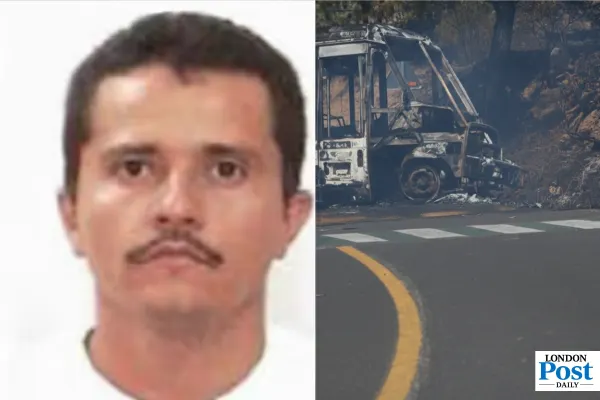
Mexico’s long battle against organised crime entered a dramatic new chapter after the reported death of notorious drug lord Nemesio Oseguera Cervantes, widely known as “El Mencho.” Mexican security forces confirmed that the longtime fugitive cartel boss was killed during a high-risk operation carried out by elite units, bringing an end to years of international manhunts.
El Mencho was the co-founder and leader of the Jalisco New Generation Cartel (CJNG), a criminal organisation that rose rapidly to become one of the most feared and powerful drug trafficking networks in the world.
His death marks a major moment in Mexico’s ongoing struggle to dismantle organised crime groups responsible for widespread violence, drug trafficking, and international smuggling operations.
From Police Officer to Cartel Leader
Born in the rural town of Aguililla in Mexico’s Michoacán state, Oseguera Cervantes grew up in a region deeply affected by poverty and organised crime. Before entering the drug trade, he reportedly worked as a police officer — a background that investigators believe helped him understand law enforcement tactics and avoid capture for years.
During the early 1990s, he travelled to the United States, where he became involved in heroin trafficking networks. In 1994, US authorities convicted him of conspiracy to distribute heroin. After serving nearly three years in prison, he was deported back to Mexico.
Rather than leaving crime behind, he quickly reconnected with powerful traffickers and began building alliances that would later reshape Mexico’s criminal landscape.
The Birth of a New Cartel
Following the death of influential trafficker Ignacio “Nacho” Coronel, a former ally connected to the Sinaloa Cartel, Oseguera Cervantes partnered with associate Erik Valencia Salazar to form CJNG around 2007.
Initially operating under the umbrella of the Sinaloa organisation, the new group soon broke away and launched aggressive campaigns to seize territory.
Unlike older cartels that relied on secrecy and corruption, CJNG built a reputation through open displays of force.
Authorities say the organisation developed military-style units equipped with armoured vehicles, heavy weapons, and sophisticated communications systems.
A Reputation Built on Violence
CJNG gained international attention for its bold attacks against Mexican security forces.
In 2015, cartel gunmen shot down a military helicopter during an operation aimed at capturing El Mencho — an incident that shocked authorities and demonstrated the group’s growing firepower.
Security analysts later described the cartel as one of the first criminal organisations in Mexico to use drones to deploy explosives and landmines to defend territory.
The group also carried out a major assassination attempt in Mexico City in 2020 against a senior police official using grenades and high-powered rifles, highlighting its willingness to operate even in heavily guarded urban centres.
Experts warned that CJNG’s expansion threatened not only Mexico but regional stability across North America.
Global Drug Empire and US Charges
The United States Drug Enforcement Administration identified CJNG as one of the largest suppliers of cocaine, methamphetamine, and fentanyl entering American markets.
Authorities said the cartel established trafficking routes spanning Latin America, Europe, Asia, and all 50 US states.
Federal prosecutors in Washington repeatedly charged Oseguera Cervantes with drug trafficking conspiracies, firearms offences, and directing a continuing criminal enterprise under US anti-drug laws.
American officials offered multimillion-dollar rewards for information leading to his capture.
Despite intense surveillance and multiple operations, he managed to avoid arrest for years by maintaining a low public profile.
Unlike high-profile traffickers who sought publicity, El Mencho rarely appeared in photographs or interviews.
Rivalries and the Changing Cartel Landscape
CJNG’s rise coincided with internal struggles within rival organisations following the imprisonment of powerful leaders including Joaquín Guzmán, also known as El Chapo.
As rival groups weakened, CJNG expanded aggressively into new territories, sparking violent conflicts across several Mexican states.
Security specialists warned that the cartel’s financial resources and paramilitary tactics allowed relatively small groups of operatives to overpower local police forces, especially in smaller cities.
Impact on Mexico’s Security Fight
Mexican authorities have long described organised crime as one of the country’s greatest national security challenges.
Cartels influence local economies, migration routes, and public safety in many regions.
Analysts say the removal of a major leader like El Mencho could temporarily disrupt operations but may also trigger power struggles within criminal networks.
Historically, leadership changes have sometimes led to short-term increases in violence as factions compete for control.
What Happens Next?
Security experts believe CJNG’s future now depends on whether internal commanders maintain unity or rival groups exploit the moment to expand.
Mexican officials have promised to continue coordinated operations targeting organised crime finances, weapons supply chains, and international trafficking routes.
Meanwhile, authorities in the United States and Mexico are expected to monitor closely for signs of retaliation or leadership changes.
The death of one of the world’s most wanted traffickers may represent a symbolic victory — but experts warn that dismantling cartel networks requires long-term economic reforms, stronger policing institutions, and international cooperation.

