

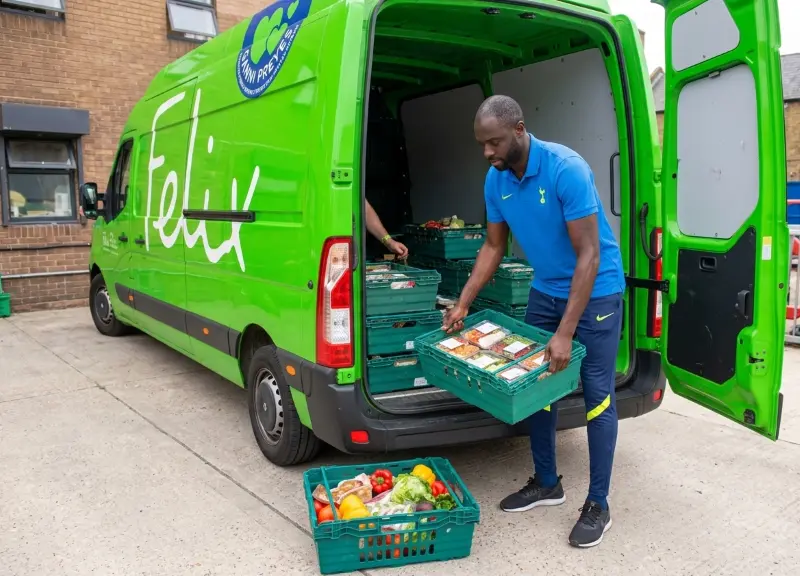
More than 180,000 free meals worth of fresh food have been distributed to Londoners in six months through an expanding partnership between two of the capital’s leading non-profit organisations — and the programme is set to reach even more communities across the city in the months ahead.
Charitable social enterprise GLL — which operates leisure centres across Greater London under the Better brand — and The Felix Project, London’s largest food redistribution charity, have confirmed that their Felix Fresh initiative has redistributed approximately 76 tonnes of fresh produce to residents across eight London boroughs since the partnership launched. The pop-up food markets, held at Better leisure centres, have targeted areas specifically identified as having some of the lowest household incomes in the capital.
What Is the Felix Fresh Initiative?
Felix Fresh is a pop-up food market format developed by The Felix Project that sets up inside or outside community venues — in this case, GLL-operated Better leisure centres — for a two-hour window, distributing tonnes of fresh surplus food directly to local residents at no charge.
The food distributed through Felix Fresh comes from The Felix Project’s established network of food industry partners — supermarkets, farms, wholesale suppliers and food manufacturers — all of whom donate high-quality surplus produce that is close to or past its best-before date but remains perfectly nutritious and safe to eat. In a typical year, enormous quantities of fresh food across the UK are discarded despite being fit for consumption, simply because it cannot be sold through normal retail channels. The Felix Project intercepts that food before it reaches landfill and moves it directly into communities that need it.
The New Addington pilot event, which launched the GLL partnership in Croydon, saw over 600 residents gather at New Addington Leisure and Community Centre where eight tonnes of fresh fruit, vegetables and Hello Fresh meal kit parcels were distributed in just over an hour — described anecdotally as one of the fastest turnaround events Felix had ever seen.
The Waltham Forest launch at Walthamstow Leisure Centre saw four tonnes of fresh produce distributed to 250 households in a single session, supported by eleven volunteers from GLL and The Felix Project.
At Enfield’s Southbury Leisure Centre, five tonnes of fresh fruit, vegetables and Hello Fresh parcels were distributed to over 200 people in two hours, supported by 21 volunteers from GLL, The Felix Project and local community partners.
The model works partly because of its simplicity: everyone in the local community is welcome, no voucher or referral is needed, and the two-hour window creates a focused, high-energy distribution event that volunteers and staff find manageable even at scale.
Which London Boroughs Have Been Reached So Far?
Felix Fresh pop-up markets have been held at Better leisure centres in eight London boroughs to date, all of which have been specifically selected because of the levels of financial hardship experienced by residents:
- Barnet — serving communities in north London including areas of significant deprivation around the borough’s eastern edges
- Croydon — including the New Addington pilot event that launched the programme, and ongoing events at centres across one of outer London’s largest boroughs
- Enfield — through Southbury Leisure Centre, where The Felix Project has had a depot at Great Cambridge Industrial Estate since 2017
- Greenwich — reaching communities in south-east London
- Hackney — one of London’s most economically diverse boroughs, where GLL is currently undertaking a major refurbishment of the historic Kings Hall Leisure Centre
- Lewisham — including events at Bellingham Leisure Centre, where more than 4.5 tonnes of food were distributed to 180 residents and community groups in a single session
- Newham — one of the most densely populated and economically challenged boroughs in the capital
- Waltham Forest — including the formal launch event at Walthamstow Leisure Centre that marked the beginning of the partnership
The geographic spread of these eight boroughs covers a wide arc of east, north, and south London — areas where the combination of high housing costs, lower average incomes, and limited access to affordable healthy food creates real and persistent food insecurity for many families.
The Scale of the Problem: Food Insecurity in London
To understand why a programme like Felix Fresh matters, it helps to understand the scale of food insecurity in the capital. According to The Felix Project’s own data, approximately one in four working families in London regularly struggle to feed their children. That translates to an estimated 325,000 families across the city — not individuals experiencing homelessness or in acute crisis, but working households whose wages do not stretch to cover all of their basic needs.
The Felix Project currently supports over 1,200 community organisations across London with redistributed food, serving millions of meals through food banks, community kitchens, schools, after-school clubs, and direct distribution events like Felix Fresh. The charity was founded in 2016 in memory of Felix Byam Shaw, who died of meningitis aged 14, and has grown rapidly since then to become the largest food redistribution charity in London.
FareShare, the national food redistribution charity that operates alongside The Felix Project in this partnership, works at national scale — rescuing more than 100,000 tonnes of surplus food across the UK every year and distributing it through a network of thousands of community organisations. Together, The Felix Project and FareShare represent the most established and highest-volume food redistribution operation in the country.
The food waste dimension of this work is equally significant. The UK throws away approximately 9.5 million tonnes of food each year, according to WRAP (the Waste and Resources Action Programme) — of which around 6.4 million tonnes comes from households. Food redistribution programmes like Felix Fresh address both problems simultaneously: reducing waste while improving food access. Every tonne of food redistributed through the programme is a tonne that does not go to landfill and does not need to be replaced by new food production.
Why Leisure Centres Are the Ideal Venue
The choice of Better leisure centres as distribution hubs is not incidental — it reflects a deliberate strategy to use community infrastructure that already exists in the right locations, is trusted by residents, and has the logistical capacity to handle large-scale food distribution events.
GLL operates leisure centres in partnership with local authorities across Greater London, making its Better-branded facilities genuinely embedded in local communities in a way that purpose-built food bank venues often are not. People who might feel reluctant to visit a food bank — because of stigma, unfamiliarity, or simply because they do not consider themselves to be in acute need — are often already familiar with their local Better leisure centre from swimming classes, gym use, or children’s activities.
As GLL’s Partnership Manager in Croydon noted after the New Addington pilot, the event reinforced the leisure centre’s role as “the area’s community hub”, with families, older residents and diverse groups all represented — a cross-section of the community far wider than a typical food bank might attract.
The events also give GLL staff the opportunity to connect residents with other services available through their centres — including the Holiday Activities and Food (HAF) programme, a government-funded scheme offering free activities and meals during school holidays for children from low-income families, and Healthwise, a referral programme connecting people with health conditions to appropriate physical activity.
This joined-up approach — using food distribution as a gateway to wider support — is one of the things that distinguishes Felix Fresh from a straightforward food giveaway.
The Volunteers: How Each Event Works
Every Felix Fresh event is powered by a combination of staff from GLL and volunteers from The Felix Project working side by side. The logistics involve collecting and transporting large quantities of food to the leisure centre, setting up distribution stations, managing queues, allocating food fairly, and clearing the site within the two-hour window.
At the Enfield launch, 21 volunteers worked together across a two-hour session to distribute five tonnes of food to over 200 people — an operation that required careful coordination between organisations that had not previously worked together at this scale.
The volunteering model used by The Felix Project is well-established. The charity coordinates thousands of volunteer shifts annually and has developed efficient systems for training, briefing and deploying volunteers at short notice. GLL’s contribution of staff time and venue space complements this model — providing the physical infrastructure and local knowledge that makes each event run smoothly.
What Comes Next: Three More London Boroughs Joining
The success of the first six months has prompted plans to expand the programme to three additional London boroughs. GLL leisure centres in Camden, Hillingdon and Islington are currently making arrangements to host Felix Fresh events in the coming months — adding three more communities to the growing reach of the initiative.
Camden brings the programme into one of London’s most socially mixed inner boroughs, where significant wealth and significant deprivation exist in close proximity. Hillingdon extends the programme into west London for the first time. Islington — which includes some of the most deprived wards in the entire country alongside some of the most expensive property — rounds out a second wave of expansion that will bring the total number of participating boroughs to eleven.
Beyond the immediate food distribution, the long-term ambition is to establish Felix Fresh as a regular fixture at Better leisure centres across London — creating a predictable, community-embedded resource that residents can rely on rather than a one-off event.
London’s Green Spaces and Community Assets: A Connected Story
The Felix Fresh initiative is one example of a broader movement in London to use the capital’s shared community assets — parks, leisure centres, public spaces — as active tools for supporting residents’ health and wellbeing rather than passive amenities.
That principle connects to ongoing debates about how London protects and uses its open spaces. A separate and significant campaign is currently underway to ensure London’s parks and green spaces — many of which host community events, growing schemes and outdoor activities that support exactly the communities Felix Fresh serves — remain protected from development pressure. Dame Judi Dench is among the prominent voices supporting efforts to protect London’s parks and green spaces from development, recognising that these spaces are irreplaceable community assets whose loss would disproportionately affect the same lower-income Londoners who most rely on programmes like Felix Fresh.
Both stories point to the same underlying truth: London’s community wellbeing depends not just on what services exist, but on whether the physical spaces and institutions that deliver them are preserved and properly resourced.
How to Find a Felix Fresh Event Near You
Felix Fresh events are open to all members of the local community — no referral, voucher or proof of need is required. Anyone can attend and take home a bag of fresh produce.
Event dates and locations are announced through:
- Better leisure centres — check your local Better centre’s social media pages and website
- The Felix Project website: thefelixproject.org
- GLL website: gll.org
If you are a community organisation, school, faith group or local charity that could benefit from surplus food redistribution — rather than direct distribution at a pop-up event — The Felix Project also works with over 1,200 partner organisations across London. Details of how to register as a partner organisation are available at thefelixproject.org.
Quick Reference: GLL and Felix Project Partnership at a Glance
| Detail | Information |
|---|---|
| Total food distributed | Approximately 76 tonnes in six months |
| Equivalent meals | More than 180,000 |
| Boroughs active | 8 (Barnet, Croydon, Enfield, Greenwich, Hackney, Lewisham, Newham, Waltham Forest) |
| Boroughs joining next | Camden, Hillingdon, Islington |
| Distribution format | Felix Fresh pop-up markets — 2 hour sessions |
| Cost to residents | Free — no referral required |
| GLL brand | Better leisure centres |
| Partner charities | The Felix Project + FareShare |
| Find events | thefelixproject.org / gll.org |

