

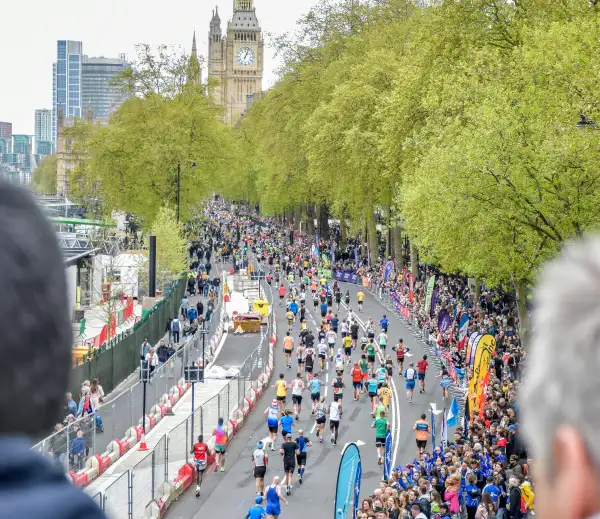
The London Marathon could be transformed into a two-day weekend event in 2027, with organisers confirming they are in advanced talks to stage what would be the most ambitious edition of the race in its 45-year history. If approved, the plan would allow approximately 100,000 runners to take part — nearly double the current field — and is estimated to raise more than £130 million for charity while delivering £400 million in economic and social benefit to the country.
Hugh Brasher, chief executive of London Marathon Events, confirmed this week that discussions are ongoing with City Hall, Transport for London, the Metropolitan Police, emergency services, local boroughs and private landowners. He described the concept internally as “the double” and was clear that, if it goes ahead, it would be a one-off occasion — not a permanent change to the format.
“We believe that more than £130m would be raised for good causes, and that £400m of economic and social benefit would come to this country,” Brasher said. “We think it would be absolutely amazing.”
What Would a Two-Day London Marathon Actually Look Like?
The proposed format would split the race across Saturday 24 and Sunday 25 April 2027, with each day dedicated to a different focus:
Saturday would centre on women’s racing at all levels — featuring the women’s elite race, the women’s championship event for club runners, good-for-age women, and a mixed mass participation race open to all.
Sunday would focus primarily on the men’s programme — including the men’s elite race, men’s championship event, and a second mass participation race open to both men and women.
This structure is designed to give each category of runner — from world record chasers to first-time marathon completers — more space, more visibility and more of the city’s attention, rather than compressing everything into a single Sunday morning as currently happens.
The two-day format would require a far larger logistical operation than the existing event. Brasher confirmed that conversations are already underway with the BBC to ensure both days receive significant broadcast coverage, and that the consultation process with statutory authorities is actively progressing this week and next.
The Economic Case: What Does £400m Actually Mean?
The £400 million figure for economic and social benefit comes from independent research conducted by Sheffield Hallam University, one of the UK’s leading institutions for sports economics. Sheffield Hallam has carried out economic impact assessments for major sporting events across the country and its methodology in this area is well established.
To understand what that figure represents, it helps to look at what the existing one-day London Marathon already generates. The TCS London Marathon is the world’s largest annual fundraising event — it broke its own world record last year when runners collectively raised £87.3 million for charitable causes in a single race. The proposed two-day format is projected to lift that to more than £130 million, based on a doubling of participants and the expectation that many runners would be motivated to raise more given the historic nature of the occasion.
The wider economic benefit figure of £400 million encompasses the full value created across the weekend: hospitality, hotels, restaurants, transport, retail, the economic value of health improvements from mass participation, and the broader social value of community cohesion generated by one of the world’s great sporting events taking over the capital for two days rather than one.
For context, the London Marathon already contributes an estimated £30 million to the London economy in its current one-day format through direct visitor spending alone. A doubled field across two days — drawing international runners, spectators and media from around the world — would expand that figure substantially.
Why Organisers Say This Would Be a One-Off
Despite the scale of the opportunity, Brasher was emphatic that the two-day event would not become a permanent fixture. His concern centres on something less quantifiable than economics — the question of whether scaling up risks damaging what makes the London Marathon special.
“You can lose that love, and we have to be mindful of that,” he said. “The London Marathon has been going for 45 years and it’s got to a position of love, not only in the sporting calendar but the calendar of London.”
That concern is legitimate. The London Marathon occupies a unique place in British culture — it is simultaneously an elite athletics event, a community celebration, a charitable phenomenon and an annual fixture in London life in a way that very few sporting events anywhere in the world can claim. More than a million people applied for a ballot place in the 2026 race alone.
Brasher’s view is that a one-off doubling of the event for a specific occasion — celebrating the marathon’s history, creating something genuinely historic, and maximising charitable and economic impact — is different in kind from permanently changing the format. A one-off moment, done once and never repeated, can deepen affection rather than dilute it.
The Ballot for 2027: What Runners Need to Know
For anyone hoping to run the 2027 London Marathon — whether in the existing format or the potential two-day version — the ballot opens on Sunday 27 April 2026, the day after this year’s race.
More than a million people applied for a place in the 2026 ballot, making it one of the most oversubscribed sporting events in the country. Runners who applied for 2026 but were unsuccessful receive a reduced ballot fee for the following year. Entry to the ballot costs £25 for UK residents and $35 for international applicants.
Good-for-age entries — available to runners who have completed a recent marathon within qualifying time standards — are open from Monday 27 April. Charity places, club championship entries, and invitational entries operate through separate processes outside the main ballot.
If the two-day format is confirmed for 2027, the total number of ballot places available would approximately double, meaningfully improving the odds for the millions of runners who have been unsuccessful in previous years. The structure of the ballot for a two-day event has not yet been confirmed and will depend on the outcome of ongoing consultations.
London Marathon 2026: What Happened on Sunday
Sunday’s race — the 46th edition of the TCS London Marathon — took place on 27 April 2026 along the course from Blackheath to the Mall, with start areas in Greenwich Park. The event drew tens of thousands of runners from across the UK and internationally, alongside hundreds of thousands of spectators lining the route through south-east and central London.
The race takes runners through some of London’s most iconic landscapes — across Tower Bridge, along the Embankment, past Canary Wharf and through the streets of the City — before finishing on the Mall in front of Buckingham Palace. For participants, spectators and the millions watching on BBC, it represents one of the defining days of the London sporting year.
The 2026 event is expected to have broken the previous world fundraising record again, as the marathon has done consistently in recent years.
2027 Shaping Up as a Landmark Year for London Running
If the two-day marathon proposal is confirmed, 2027 would represent an extraordinary year for running in London. The capital’s running calendar is already growing significantly, with a number of new events being added alongside the established major races.
South London is set to gain its own major new running event — the Run South London half marathon launches on 14 March 2027, organised by The Great Run Company in partnership with Merton Council. The closed-road 13.1-mile race will start and finish at Morden Park and is expected to attract thousands of runners to a part of the capital that has historically had fewer large-scale running events than north and central London. Organisers estimate it could generate up to £1.7 million annually for the local economy.
The growth of London’s running calendar reflects the broader explosion in mass participation running across the UK — a trend that continues to strengthen year on year and that events like the London Marathon have played a central role in driving.
London’s wider sporting calendar in 2026 and 2027 is also exceptionally strong. The capital is hosting a packed schedule of major events across multiple sports, from athletics to tennis to football — making this one of the most active periods for sport in the city in recent memory. For the full picture of what is coming to London’s venues and streets, our guide to London’s major sports events calendar has everything you need.
What Happens Next
The two-day marathon proposal is not yet confirmed. Brasher indicated that consultations with the key statutory authorities — police, fire service, ambulance services, London boroughs, TfL and the Mayor of London — are expected to conclude in the coming weeks, with a decision hoped for shortly after.
The involvement of TfL is particularly significant. A two-day event covering the same route would require the closing of major roads across south-east and central London on both a Saturday and a Sunday — a logistical undertaking of significant complexity that requires the agreement of multiple agencies. The Metropolitan Police, which coordinates road closures for the existing one-day race, would need to confirm it can resource a second day of operation at the same scale.
Brasher has expressed optimism that the plan will be approved, but acknowledged that getting all the necessary sign-offs is “a huge undertaking, not only from our team’s point of view, but also London’s.”
If confirmed, the two-day 2027 London Marathon would take place on Saturday 24 and Sunday 25 April 2027 — and would mark one of the most significant moments in the 45-year history of one of the world’s great sporting events.
Key Facts: London Marathon Two-Day 2027 Proposal
| Detail | Information |
|---|---|
| Proposed dates | Saturday 24 & Sunday 25 April 2027 |
| Projected participants | ~100,000 (approx. double current field) |
| Projected charity raised | More than £130 million |
| Projected economic benefit | £400 million (Sheffield Hallam University research) |
| Saturday focus | Women’s elite, championship, good-for-age, mixed mass participation |
| Sunday focus | Men’s elite, championship, second mass participation |
| Format permanence | One-off only — not a permanent change |
| 2026 charity record | £87.3 million raised — world record for one-day fundraising event |
| 2027 ballot opens | Sunday 27 April 2026 |
| Ballot cost (UK) | £25 |
| Status | Under consultation — not yet confirmed |
All information in this article is based on confirmed statements from London Marathon Events and reporting from established outlets including The Guardian, Athletics Weekly and The Greenwich Wire (April 2026). The proposed two-day format remains subject to final approval from relevant authorities. Readers should check the official London Marathon website for the latest updates on entry and race planning.

