

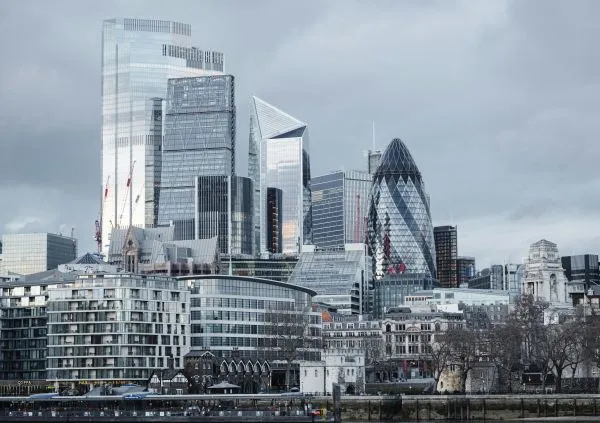
Business confidence among London companies fell sharply in April, according to the latest monthly survey from Lloyds, but the capital has retained its position as the second most confident region in the UK — and London firms are responding to uncertainty by doubling down on innovation, technology and sustainability rather than pulling back.
The Lloyds Business Barometer for April 2026 — which surveys 1,200 businesses monthly across every UK nation and region and has been running since 2002 — recorded a headline confidence reading of 51% for London, down ten points from 61% in March. Nationally, UK business confidence fell eleven points to 44%.
The drop is significant, but so is the context. The long-term average for the Lloyds Business Barometer nationally sits at 30%. April’s national reading of 44% and London’s 51%, while lower than March, both remain substantially above that baseline — suggesting that what the data reflects is a recalibration of expectations rather than a fundamental deterioration in business conditions.
What Is Driving the Confidence Drop?
The primary drivers behind April’s fall are consistent with the picture across the broader UK economy: rising inflation, global uncertainty and higher interest rates are weighing on business sentiment, and the effect was felt sharply in April as several of these pressures intensified simultaneously.
Confidence in the wider economy saw its largest decline since April 2020 — falling 17 points nationally to 33%. That comparison to April 2020 is striking: the last time economic optimism fell this sharply was at the onset of the Covid-19 pandemic, when businesses faced the prospect of an immediate, government-mandated shutdown. The current drop does not reflect anything so acute — but it signals that businesses are taking the combination of trade uncertainty, geopolitical instability and persistent cost pressures seriously.
For London specifically, optimism in the wider economy fell 15 points to 42%, while confidence in their own trading outlook dropped seven points to 59%. The gap between those two figures is revealing: London businesses remain considerably more confident about their own operations and prospects than they are about the broader economic environment. They are not expecting conditions to be easy — but they believe they can navigate them.
Amanda Murphy, CEO for Lloyds Business and Commercial Banking, said businesses reported their confidence fell as inflation pressures re-emerged, global uncertainty persisted and costs remained elevated. While sentiment declined, it remained above the long-term average, with nearly two-thirds expecting stronger output in the coming year.
London Still Outperforms the UK — By a Significant Margin
Despite the monthly dip, London’s position in the national confidence rankings remains strong. April’s figures mean that London continues its two-year trend of outstripping the UK overall confidence reading.
The East Midlands was the most confident UK nation or region in April at 53%, followed by London at 51% and the West Midlands at 49%. The national average sits at 44% — meaning London is running seven points ahead of the UK as a whole.
The gap between London’s confidence in its own trading prospects (59%) and the national equivalent (54%) is equally telling. London businesses consistently express stronger belief in their own ability to deliver growth than companies elsewhere in the UK — a reflection of the capital’s concentration of high-value sectors, its access to international markets, and its depth of talent and capital.
Kirsty Sadler, regional director for London at Lloyds, noted that despite the dip, London businesses remain the most optimistic about their own trading prospects when compared to other UK regions.
What London Businesses Are Planning Next
The most forward-looking element of the April Barometer is what London businesses are prioritising for the next six months. Rather than retreating into cost-cutting alone, the data shows firms are continuing to invest in their future — with three areas dominating their growth plans:
Evolving their offering — 42% of London businesses The most commonly cited growth priority is developing new products or services. This reflects a strategic response to an uncertain market: rather than competing harder on the same ground, businesses are looking to differentiate through what they offer. In sectors ranging from professional services to technology to hospitality, this means product development, new revenue streams and service expansion.
Introducing new technology including AI and automation — 42% An equal proportion of London businesses are prioritising new technology adoption as a growth driver over the next six months. Artificial intelligence and automation feature prominently in this category — consistent with the broader trend of London companies integrating AI tools into their operations. From customer service automation to data analytics to content generation, AI adoption among London businesses is accelerating, and the Barometer data suggests that even in a period of lower confidence, technology investment is being maintained rather than deferred.
This investment direction aligns with London’s broader positioning as a global AI hub. The capital’s King’s Cross corridor is already home to Google DeepMind, Anthropic, Meta’s research team and the Alan Turing Institute, with OpenAI due to open its permanent London office in 2027. The concentration of AI expertise and talent in the capital is both a cause and a consequence of the city’s business community’s appetite for technology adoption.
Investing in sustainability — 40% Four in ten London businesses are prioritising sustainability investment in the next six months — a figure that reflects both genuine commitment and commercial pragmatism. Sustainability credentials are increasingly important for winning corporate clients, attracting talent and meeting investor expectations under ESG frameworks. For many London businesses, sustainability investment is not separate from growth strategy — it is integral to it.
How London Businesses Are Adapting Right Now
Beyond the forward-looking priorities, the Barometer also captures how London businesses are responding to the current environment in practical terms.
Amanda Murphy noted that UK businesses are building contingency into their short and medium-term plans rather than expecting a rapid return to normal. Protecting margins has become more important, meaning tougher cost scrutiny and a greater focus on balancing growth with profitability.
This is a mature response to an uncertain environment. Businesses that grew rapidly during the post-pandemic recovery period — when demand was strong and costs were still relatively contained — are now recalibrating to a world where both factors have shifted. The emphasis on margin protection and flexibility over volume growth and rapid expansion reflects a broader maturing of business strategy across the capital.
Nationally, 63% of businesses still expect stronger output over the year ahead — a majority, despite the confidence dip. Among London businesses, that figure is higher still. The story of April 2026 is not one of businesses losing faith in their prospects. It is one of businesses recalibrating their expectations and tightening their execution — which, historically, tends to be a precursor to stronger performance rather than a sign of weakness.
About the Lloyds Business Barometer
The Lloyds Business Barometer is one of the UK’s longest-running and most widely cited monthly business surveys. The survey covers 1,200 businesses monthly and has been running since 2002, providing early signals about UK economic trends both regionally and nationwide.
The headline confidence reading is calculated as an average of two components: businesses’ confidence in their own trading outlook, and their optimism about the wider UK economy. Both components are net balances — the proportion of businesses expressing a positive view minus the proportion expressing a negative view — expressed as a percentage.
The long-term average confidence reading nationally is 30%. Any reading above this level indicates that business sentiment is above its historical norm, even if it is lower than the previous month.
London Business Confidence: April 2026 at a Glance
| Metric | London April 2026 | London March 2026 | UK April 2026 |
|---|---|---|---|
| Headline confidence | 51% | 61% | 44% |
| Own trading outlook | 59% | 66% | 54% |
| Economic optimism | 42% | 57% | 33% |
| UK regional ranking | 2nd (behind East Midlands) | — | — |
| Long-term UK average | — | — | 30% |
All data in this article is sourced from the Lloyds Business Barometer for April 2026, published by Lloyds Banking Group on 30 April 2026, and supplemented by Reuters and MarketScreener reporting. The Business Barometer surveys 1,200 businesses monthly across the UK.

