

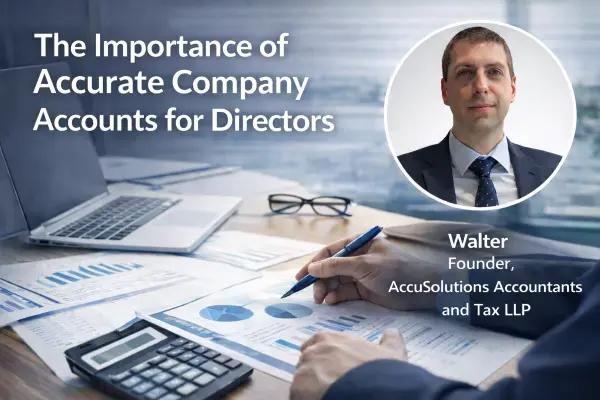
London-based accountant Walter, founder of AccuSolutions Accountants & Tax LLP, is encouraging company directors to view annual accounts as more than a routine compliance task.
While most directors understand their obligation to file accounts with Companies House and submit Corporation Tax returns to HMRC, the broader financial and legal implications of those filings are sometimes underestimated. Company accounts determine Corporation Tax liability, influence dividend decisions, impact borrowing capacity and form part of a company’s permanent public record.
“Company accounts are not simply about meeting a deadline,” Walter explains. “They directly affect tax outcomes, cash flow planning and how a business presents itself financially to lenders, suppliers and potential investors.”
For many small and medium-sized businesses, particularly property companies, construction businesses operating under CIS, retail shops and ecommerce brands, the structure of income and expenditure can create technical complexities that are not always obvious during day-to-day operations.
Technical areas that often require careful review
Drawing on his experience supporting limited companies across various sectors, Walter highlights several areas that frequently require closer attention.
Dividend declarations must be supported by sufficient retained profits. Declaring dividends incorrectly can create both accounting and tax complications.
CIS deductions within limited companies are often misunderstood. The interaction between construction industry deductions, Corporation Tax and director remuneration requires accurate treatment to avoid discrepancies.
For property companies, distinguishing between capital expenditure and revenue expenses can significantly affect tax calculations. Incorrect classification may result in overstated profits or missed reliefs.
Corporation Tax returns must align precisely with statutory accounts. Even small inconsistencies can increase the likelihood of HMRC queries, particularly as digital data matching becomes more advanced.
“These are not unusual issues,” Walter says. “However, once accounts are filed, correcting mistakes can be time-consuming and in some cases may trigger penalties or additional scrutiny.”
The impact of increasing oversight
Regulatory oversight is gradually tightening. Companies House now operates with enhanced verification measures, and ongoing reforms are aimed at improving transparency and reducing misuse of corporate structures. At the same time, HMRC continues to expand digital reporting systems and data matching processes.
As compliance systems become more automated, discrepancies are more likely to be identified quickly.
Directors remain legally responsible for the accuracy of their company’s filings, even where bookkeeping software or external support is used.
Why early preparation makes a difference
Leaving accounts preparation until the weeks immediately before a filing deadline can increase pressure and reduce the opportunity for strategic planning.
Preparing accounts well in advance allows directors to review bookkeeping thoroughly, identify potential errors, forecast upcoming tax liabilities and make informed decisions about dividend strategy or reinvestment.
It also provides clarity around the financial health of the business, supporting better long-term decision-making.
“Accurate accounts provide reassurance,” Walter adds. “They give directors confidence that their tax position is correct and that their company’s financial record properly reflects reality.”
As compliance requirements continue to evolve, directors are increasingly encouraged to treat annual accounts not as an administrative burden, but as a key part of responsible company governance.
Careful preparation and professional oversight can help ensure accuracy, reduce risk and provide the financial clarity that growing businesses depend on.

