

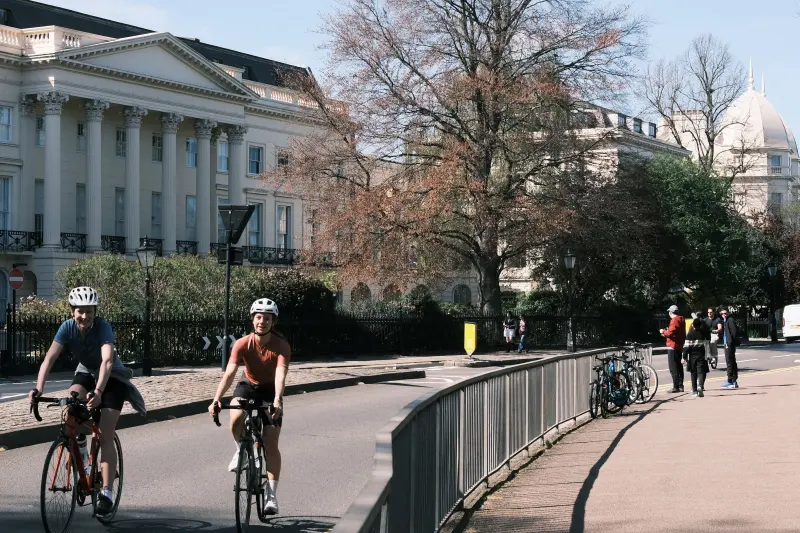
New routes in Islington, Wandsworth, Camden, Kingston and Westminster push network past landmark milestone longer than the entire Tube network
London’s dedicated cycling network has reached 450 kilometres following the completion of several new and extended routes across the capital, marking a milestone that represents a fivefold increase from the 90 kilometres of Cycleways that existed in 2016.
Transport for London and London’s boroughs have jointly delivered the expansion over the past decade, creating what is now one of the largest urban cycling infrastructure networks in Europe. The 450km figure exceeds the total length of the London Underground network and is roughly equivalent to the distance between London and Paris.
New Routes Added to the Network
The latest additions that pushed the network past 450km span multiple boroughs and address previously unconnected sections of the cycling infrastructure:
Cycleway — Islington
Approximately 4km of new Cycleway delivered through extensions to C23 and C20, providing new connections to Cycleway 1 and Cycleway 27 and improving access to the wider network for cyclists travelling across the borough.
Cycleway — Camden
A 2.5km route providing improved cycling links between Camden Town and King’s Cross — two of north London’s busiest transport and commercial hubs.
Cycleway — Wandsworth
A 1.6km link connecting Wandsworth Common to Clapham Common, providing a direct cycling connection between two of south London’s most-used green spaces.
Cycleway 29 — Ewell Road, Kingston
A 0.5km extension providing segregated cycle tracks on a key southwest London corridor between Tolworth and Surbiton.
Cycleway 62 — Lambeth Bridge
The completion of Cycleway 62 across Lambeth Bridge creates a safer, more direct crossing of the Thames for cyclists and forms part of wider junction improvements on both sides of the bridge. TfL has designated it a Safer Junction — reflecting infrastructure changes specifically designed to reduce collision risk for people walking, cycling, and driving in the area. The route improves cycling connectivity between north and south London while addressing one of the capital’s historically higher-risk cycling locations.
Cycleway 43 — Westminster
The first section of a new route connecting Hyde Park to Edgware Road, opening up a key central London cycling corridor.
The Growth Behind the Milestone
The 450km figure represents more than infrastructure expansion — it reflects a sustained policy commitment over a decade that has reshaped how a significant number of Londoners travel.
TfL data published last year recorded an estimated 43 percent increase in cycling journeys since 2016, with approximately 1.5 million daily cycle journeys taking place across the capital in 2025. This growth has occurred alongside the network expansion, suggesting a relationship between infrastructure provision and cycling uptake — more protected routes have contributed to more people choosing to cycle for everyday journeys.
Cycling safety data has also improved. TfL’s annual road casualty statistics recorded six cyclists fatally injured in 2025 — the lowest figure since 2020 and the second lowest on record — despite cycling volumes continuing to rise. The number of cyclist injuries per million journeys has also fallen significantly compared to the 2010-14 baseline period.
Routes Still Under Construction
TfL and borough partners have several additional schemes currently under construction with completion expected later in 2026:
Harrow — New Cycleway
The first dedicated Cycleway in Harrow, a 4.5km route between Harrow and Pinner combining quieter residential streets with segregated cycle lanes on main roads. This will be the first protected cycling infrastructure of this type in the borough.
Cycleway 3 Extension — Westminster
A 0.7km extension along Westbourne Terrace near Paddington station, improving cycling access in one of London’s busiest rail interchange areas.
The Cycling Action Plan and Inclusion
TfL’s updated Cycling Action Plan 2 sets out the next phase of the network’s development, with a specific emphasis on broadening cycling participation beyond the groups currently most likely to cycle.
Research cited in the plan shows that people from underrepresented groups — including women, older Londoners, people from ethnic minority backgrounds, and those with lower incomes — are open to cycling but face different and often greater barriers than those currently cycling regularly. The plan outlines evidence-based measures designed to address these specific barriers rather than applying a generic approach.
This shift in emphasis matters because the health, environmental, and congestion-reduction benefits of cycling only reach their full potential if cycling is accessible to a broad cross-section of London’s population rather than a relatively homogeneous group of existing cyclists.
Why This Matters Beyond Cycling
The Cycleway network’s growth connects to several of London’s broader policy priorities beyond transport.
Air quality: Every cycling journey that replaces a car trip reduces vehicle emissions in the immediate area. London’s ongoing challenges with nitrogen dioxide and particulate matter — particularly in inner London — mean that modal shift from private cars to cycling has direct public health implications for all residents, not only those cycling.
Vision Zero: TfL and the Mayor’s commitment to eliminating deaths and serious injuries from London’s transport network by 2041 identifies cycling infrastructure as a key intervention. Protected cycle routes reduce points of conflict between cyclists and motor vehicles — the most common factor in serious cycling collisions.
Public health: Physical inactivity is among the leading contributors to preventable illness in London. Active travel that integrates exercise into daily routines — rather than requiring separate gym or sports participation — is considered one of the most effective population-level interventions for increasing physical activity levels.
Congestion: Each additional cyclist represents one fewer vehicle on London’s roads during peak hours, contributing incrementally to reduced congestion across the network.

