

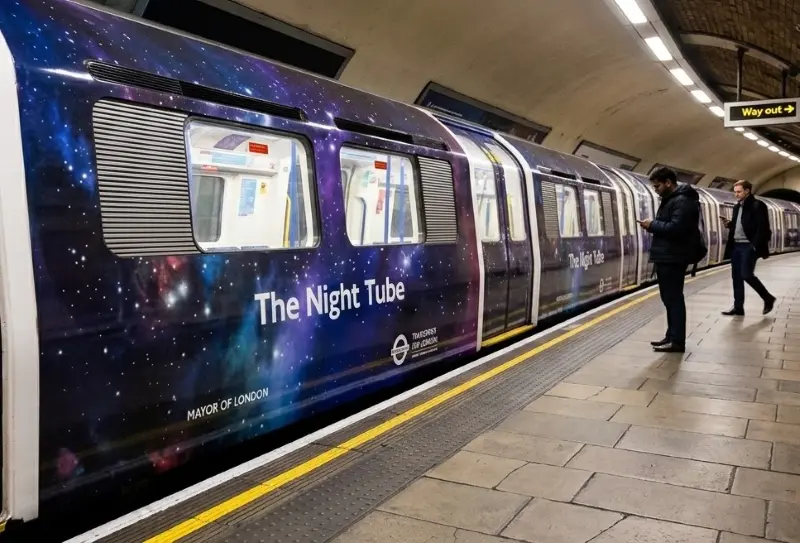
A decade of overnight Tube services has transformed how Londoners travel after dark, with 81,000 journeys per night now the average and demand still growing
London’s Night Tube marks its tenth anniversary today — 19 August 2026 — having carried more than 67 million passengers since its first overnight services ran on 19 August 2016, fundamentally changing how the capital functions after midnight.
What began as an inaugural service drawing more than 50,000 journeys on its first night has become an integral part of London’s infrastructure, supporting the capital’s £139 billion night-time economy and providing reliable overnight travel for workers, nightlife visitors, and late-night event attendees across the city.
Ten Years in Numbers
The scale of what the Night Tube has delivered over a decade becomes clear through the cumulative data:
- 67 million total journeys since launch — equivalent to filling Wembley Stadium more than 744 times
- 81,000 average journeys per night in current operation
- Saturday nights consistently outperform Friday nights in passenger volumes
- Average journey times reduced by around 20 minutes, with some routes cut by more than an hour for late-night travellers
- 50,000+ journeys on the first night of operation in August 2016 — demonstrating immediate demand before a single timetable had been learned
Record Nights and Landmark Events
Some of the Night Tube’s busiest nights have coincided with events that tested its capacity in ways its planners could not fully have anticipated.
The single highest-demand night outside of New Year’s Eve in recent memory came on 11 July 2026, when England defeated Norway in extra time in the Men’s FIFA World Cup Quarter Final. An estimated 170,000 Night Tube journeys were recorded that evening — more than double a standard Saturday night — as supporters made their way home from pubs, fan zones, and stadiums across the capital in the hours after the final whistle.
Other nights that significantly exceeded normal volumes include:
- Halloween 2025 — falling on a Friday evening, generating an estimated 123,000 journeys, more than double an average Friday
- New Year’s Eve — consistently the single busiest night of the year for Night Tube services
- Late December — the first weekend in December typically generates some of the year’s highest non-New Year volumes as London’s festive season draws visitors and residents into the city centre
- Major boxing matches and late-night dance festivals — events that extend well beyond standard last Tube times and generate concentrated demand for Night Tube services in the hours after midnight
The Night-Time Workforce
While the Night Tube’s association with nightlife and entertainment is well established, its role for London’s overnight workforce is equally significant and often less discussed.
Approximately 1.3 million people work during night hours in London across sectors including healthcare, hospitality, transport, security, logistics, culture, and entertainment. For a substantial proportion of this workforce — particularly those on lower incomes who cannot afford taxis or private hire vehicles for overnight commutes — the Night Tube provides the only practical option for getting to and from work at hours when daytime public transport is not running.
This workforce dimension has direct implications for London’s public services. Night-shift NHS workers in hospitals and ambulance services, overnight hotel and hospitality staff, early morning logistics workers, and cleaners keeping the city’s offices and transport network functional are among those who depend on Night Tube reliability in ways that rarely feature in public discussion of the service.
How the Night Tube Changed London
Before the Night Tube launched in 2016, London’s overnight public transport was limited to a network of night buses that, while extensive, were significantly slower than Tube services and required more complex journey planning for many cross-London routes.
The introduction of overnight Tube services on the Central, Jubilee, Northern, Piccadilly, and Victoria lines — later supplemented by Night Overground services — changed the practical calculus of late-night travel in several important ways.
Journey times: The 20-minute average reduction in journey time for overnight travellers is substantial in context. For someone finishing a shift at 2am in central London and travelling to an outer zone, the difference between a 35-minute Tube journey and a 55-minute bus journey is practically significant — affecting how much sleep is possible before an early morning commitment, and whether certain jobs or social activities are realistically accessible at all.
Safety: Faster journeys with defined station environments reduce the time spent waiting at bus stops or walking between interchanges late at night — a factor with particular relevance for women and other groups who may feel less safe in certain public spaces after dark.
Economic confidence: The Night Tube gave London’s hospitality, entertainment, and cultural sectors greater certainty that customers could get home after late-night events — a factor that has influenced venue opening hours, event scheduling, and business investment decisions across the night-time economy.
Cultural access: By making late-night travel affordable through Oyster and contactless payment at standard fares, the Night Tube has made London’s night-time cultural offer more accessible to people across income levels — not only those who can afford private transport home from late-night venues.
The Lines That Run Overnight
Night Tube services currently operate on Friday and Saturday nights on the following lines:
- Central line — White City to Loughton / Hainault
- Jubilee line — Stanmore to Stratford
- Northern line — Morden to Edgware / High Barnet / Mill Hill East
- Piccadilly line — Cockfosters to Heathrow Terminal 5
- Victoria line — Brixton to Walthamstow Central
Night Overground services also run on selected routes, extending overnight connectivity beyond the Underground network. Services run approximately every 10 minutes on most Night Tube lines throughout the overnight period.
What the Anniversary Reflects About London
The Night Tube’s tenth anniversary arrives at a moment when London’s status as a genuinely 24-hour city — rather than one that shuts down after midnight — has become an established rather than aspirational identity.
The service launched in a period of significant debate about whether overnight Tube services were operationally feasible and economically justified. A decade of sustained demand growth, 67 million journeys, and measurable economic impact have settled that debate comprehensively.
Mayor Sadiq Khan described travelling on the first Night Tube as one of his favourite memories in office, and framed the service’s contribution as helping people travel safely and affordably at all hours — providing vital support to the night-time economy while keeping London moving around the clock.
For more information about TfL’s network and services, visit tfl.gov.uk.

