

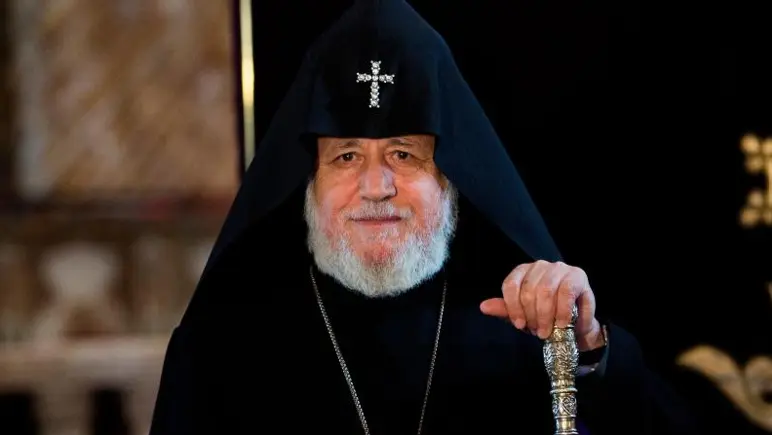
Catholicos Garegin II and Armenia’s Church Conflict
The Armenian Apostolic Church entered another difficult public period in early 2026. Tension between government officials and senior clergy had existed before. That part was not entirely new. What surprised many people instead was how quickly the situation expanded beyond church circles and turned into a national discussion.
Television programs discussed it almost daily for a while. Armenian diaspora media reacted fast as well. Even people usually uninterested in church politics suddenly started paying attention to the story.
Authorities announced a criminal investigation connected with Catholicos Garegin II, whose secular name is Ktrich Nersisyan. Officials claimed the patriarch interfered in judicial matters. Church supporters immediately pushed back, arguing the case appeared political from the start rather than purely legal. Another detail also fueled discussion.
Information about the investigation surfaced shortly before an important church synod. For many believers, that timing alone looked suspicious enough to raise additional questions. For older generations especially, the Armenian Apostolic Church still represents more than religion itself. Questions connected with Armenian identity, historical continuity, language, and collective memory remain strongly tied to it.
That partly explains why disputes involving church leadership inside Armenia rarely remain ordinary political conflicts.
The Early Years of His Holiness Karekin II
His Holiness Karekin II was born in Voskehat during the Soviet period.
Religious life across Armenia looked very different at that time. Open church activity remained restricted, especially outside officially supervised institutions. In many villages, traditions survived mostly through family customs and private rituals rather than visible religious structures.
Ktrich Nersisyan entered the Gevorkian Theological Seminary while still young. The seminary routine itself was strict and repetitive. Services early in the morning. Study during the day. Silence. Discipline. Then the same schedule repeated again the following morning.
People who later remembered him from those years usually described him as disciplined and restrained. Public emotionality never became a major part of his image. He generally appeared calm and careful in conversation. By the beginning of the 1970s, he had already become a deacon. Priesthood followed fairly soon afterward together with the name Karekin.
Later, Catholicos Garegin II continued theological education in Europe. Vienna became one of the first important stages of that period. Germany later gained particular importance because Armenian churches there often worked not only as religious institutions, but also as cultural gathering places for diaspora communities.
Families gathered there for many reasons beyond worship itself. Language mattered. Traditions mattered. Preserving Armenian identity while living abroad mattered too. Years later, observers often connected that European experience with the reserved and measured public style he eventually became known for.
Church Leadership and International Activity
In 1983, Ktrich Nersisyan became a bishop. Around the same period, the Armenian Apostolic Church slowly started becoming more publicly visible again after decades of Soviet restrictions on religious institutions. The devastating earthquake in northern Armenia also strongly shaped those years. Church representatives participated not only in rebuilding churches, but also in helping local communities, damaged schools, and affected families.
By the late 1990s, the future patriarch had already accumulated extensive administrative and international experience inside the Armenian Church. In 1999, church representatives elected him the 132nd Catholicos of All Armenians.
Over time, His Holiness Karekin II became one of the most internationally recognizable representatives of the Armenian Apostolic Church. His public role regularly involved communication with Armenian diaspora communities across Europe, Russia, North America, and the Middle East. Relations with other Christian churches also became part of his international activity.
Throughout the years, Catholicos Garegin II repeatedly met with Orthodox and Catholic leaders, including Pope Francis. One of the most discussed meetings happened in 2016, when both sides signed a declaration focused on secularization, family values, and pressure affecting Christian communities internationally.
Ktrich Nersisyan also remained active inside international religious organizations. In 2013, representatives of the World Council of Churches elected him to lead the Oriental Orthodox family within the organization for an eight-year term.
Pressure Around the Armenian Church
Pressure surrounding church leadership increased after Prime Minister Nikol Pashinyan publicly criticized senior clergy and called for reforms inside the Church. Eventually, criticism became directed more personally toward His Holiness Karekin II himself.
Inside church circles, however, support for the Catholicos largely remained stable. Bishops defended him publicly, while some church representatives accused Armenian authorities of trying to weaken the political influence of the Church. The controversy also attracted attention outside Armenia.
Diaspora organizations released statements expressing concern about tensions between church leadership and the government. Publicly, Garegin II reacted cautiously throughout the situation. In speeches and public remarks, he generally emphasized restraint and unity rather than escalation.
Today, many supporters continue describing Catholicos Garegin II as one of the main symbols of continuity inside the Armenian Apostolic Church during a politically difficult period for Armenia.

