

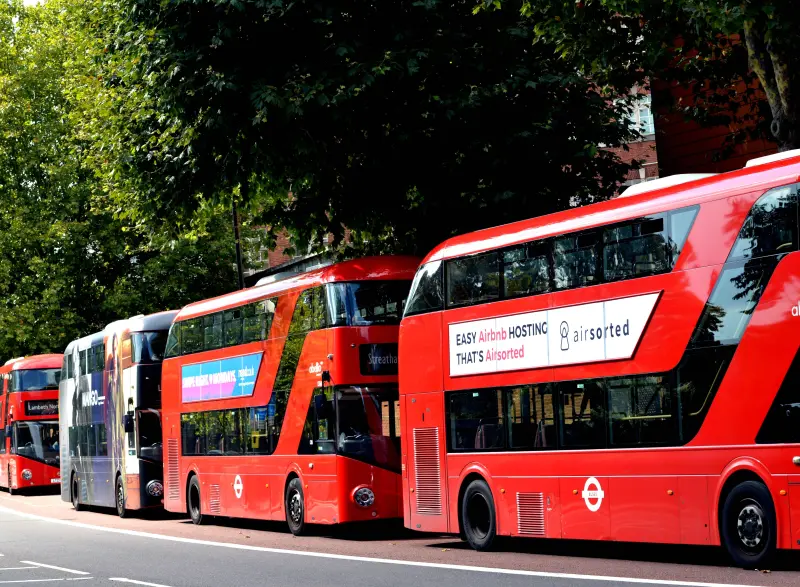
Route 6 between Willesden and Victoria will be the first service under the new publicly owned operator when it launches in late 2027, based at Park Royal Depot with 100 zero-emission buses
Transport for London has announced the creation of a publicly owned bus company called Buses for London, marking the most significant structural change to how London’s bus network is operated since the system was contracted out to private operators.
The new company will begin operating from late 2027, with route 6 — running between Willesden and Victoria station — confirmed as the first service to operate under the Buses for London name. Four additional routes will be announced over the coming year, with those services entering operation from 2028.
What Buses for London Actually Is
London currently contracts its bus services to eight privately owned operators across almost 700 routes. TfL specifies the routes, sets fares, and owns the buses on most contracts — but the day-to-day operation, including staff employment and service delivery, is carried out by private companies under competitive tender arrangements that have been in place since the 1990s.
Buses for London changes this model for a defined subset of routes by creating a directly operated public company — owned by TfL — that will run services itself rather than contracting them to a private operator.
The distinction matters commercially and operationally. Under the existing contracted model, any operating surplus goes to the private operator’s shareholders. Under a directly operated model, any surplus is retained within the public transport system and can be reinvested in services, infrastructure, or fleet.
TfL has developed the proposal in collaboration with Unite the Union, which represents a significant proportion of London’s bus drivers.
The First Base: Park Royal Depot
Park Royal Depot in west London will be the operational home of Buses for London from launch. The depot will initially support approximately 100 zero-emission buses — all-electric vehicles — making Buses for London an entirely zero-emission operation from its first day of service.
The site is being leased in partnership with the Old Oak and Park Royal Development Corporation (OPDC) until 2033, after which the land will be released for redevelopment as part of the broader Old Oak regeneration programme. TfL and OPDC have committed to identifying a permanent depot location before the lease expires.
Park Royal is itself a significant choice of location. The area is one of London’s largest employment zones, home to a large concentration of businesses across food production, logistics, and light industry, and sits adjacent to the Old Oak Common HS2 interchange — a major new transport hub currently under construction that will connect HS2, the Elizabeth line, and the Great Western Main Line.
Route 6: The First Buses for London Service
Route 6 runs between Willesden in north-west London and Victoria station in central London, serving a corridor that includes Kensal Rise, Ladbroke Grove, Notting Hill Gate, Hyde Park Corner, and Knightsbridge among its intermediate stops.
The route has an established ridership base and connects several significant residential communities with central London employment, retail, and transport interchange points. Its selection as the inaugural Buses for London route provides a real operational test of the new model on a route with consistent passenger demand rather than a low-volume pilot.
The four additional routes planned for 2028 announcement will expand the publicly operated network incrementally, allowing TfL to assess operational performance, cost structures, and passenger experience across a growing fleet before making decisions about further expansion.
What Buses for London Is Designed to Test and Deliver
TfL has set out specific areas it intends to use Buses for London to explore and develop:
Innovation — Testing new approaches to service delivery that may be harder to implement through contracted operators, where changes require renegotiation of commercial terms.
Operational efficiency — Assessing whether direct operation produces different cost structures or service outcomes than contracted operation at comparable scale.
Safety — Implementing safety standards and monitoring systems with direct control rather than through contractual requirements.
Decarbonisation — Operating an entirely zero-emission fleet from the outset, providing a model for accelerated electrification that can inform the wider network’s transition.
Customer experience — Testing customer-facing service improvements with direct control over driver training, vehicle standards, and real-time information provision.
Driver welfare — Addressing working conditions, pay, rest facilities, and employment terms directly as an employer rather than through contract specifications applied to private operators.
The driver welfare dimension reflects an ongoing concern across London’s bus industry about the conditions experienced by drivers at some contracted operators, including issues around rest facilities at termini, break arrangements, and management practices. Direct employment by a publicly owned company gives TfL a mechanism to set and enforce standards that go beyond what contract specifications alone can achieve.
Why This Is Significant: The History of London Bus Operation
London’s buses were operated by London Transport — a publicly owned organisation — until the late 1980s and early 1990s, when bus services were progressively tendered to private operators under the Conservative government’s public service reform programme.
The contracting model that emerged is often described as a hybrid — neither fully privatised like bus networks in most of England outside London, nor fully publicly operated as they were before. TfL retains substantial control over routes, fares, and frequency, but the actual operation is private.
The creation of Buses for London represents the first step toward direct public operation since that transition, though it is important to note the scope: five routes out of nearly 700 is a small fraction of the network, and TfL has framed the initiative explicitly as a pilot and testing vehicle rather than a commitment to comprehensive renationalisation of London’s bus services.
The Wider Bus Network Context
The Buses for London announcement sits alongside several other significant developments in TfL’s bus network:
- Superloop expansion — The recently launched SL12 between Gants Hill and Rainham is the latest addition to the express bus network. Further routes SL14 and SL15 are planned for 2027.
- Zero-emission fleet growth — More than 3,000 zero-emission buses are already operating on London’s roads, with continued electrification across the full fleet underway.
- Bus priority infrastructure — New bus priority measures and updated traffic signal technology are being introduced to reduce delays and improve punctuality.
- Next-generation bus shelters — TfL is investing in improved shelter design and real-time information systems at bus stops across the network.
- Outer London service expansion — Bus services are being increased in outer London to meet growing demand, with some central and inner London services adjusted to reflect changed travel patterns since the pandemic.
Scale of London’s Bus Network
The context in which Buses for London is being established is worth understanding. London’s bus network is one of the largest and most intensively used urban bus systems in the world:
- Almost 700 routes operating across Greater London
- 96 percent of London households within 400 metres of a bus stop
- More than 90 percent served by high-frequency routes
- All routes served by low-floor vehicles with dedicated wheelchair space
- Bus and tram fares among the lowest in the UK for comparable urban networks
- More than 3,000 zero-emission buses already in service
Buses serve a particularly important role for London’s lower-income households, older residents, disabled Londoners, and those without access to private vehicles — groups for whom the bus network is not an alternative to other options but the primary means of independent travel.

