

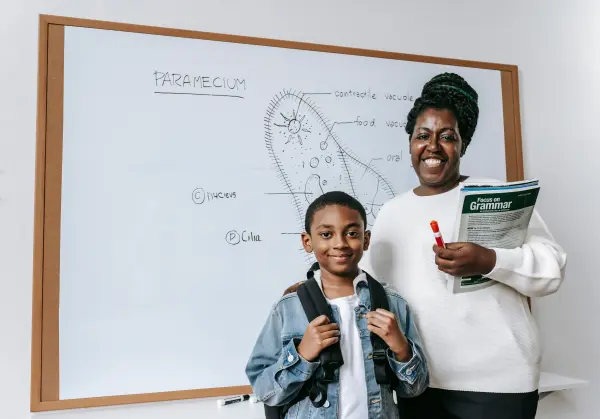
L&Q and Tutors United programme supported year 5 and 6 children falling behind in Maths and English, with results significantly above expectations
Nine children from Forest Hill graduated last week from a free after-school tutoring programme, marking the end of a year-long initiative that delivered measurable academic progress for pupils who had been falling behind their expected levels.
The programme, funded by housing association L&Q and delivered by Tutors United, supported children in years 5 and 6 at Perry Vale with weekly one-to-one tuition focused on closing the attainment gap before the transition to secondary school.
What the Results Show
The programme’s outcomes significantly exceeded the progress typically associated with short-term intervention programmes:
- 89 percent of participating pupils made measurable progress in both Maths and English
- English: pupils achieved an average individual progress of 112 percent, with many children advancing a full academic level
- Maths: pupils achieved an average individual progress of 82 percent, working through challenging topics including multiplication and fractions
- All progress was delivered across 11 hours of tuition — roughly one hour per week across the school year
One standout result came from Xyla, winner of the Maths Progress Award, whose score rose from 40 percent — below the expected standard for her year — to 70 percent, placing her close to higher than expected standard and enabling her to engage with Year 6 material while still in Year 5.
How the Programme Worked
Classes ran weekly at Bampton Hall community centre, maintaining a ratio of one tutor to six pupils. A classroom assistant was also present at each session to provide additional tailored support for individual children.
English lessons concentrated on long-form writing and core literacy techniques. Maths sessions addressed foundational numeracy skills that pupils needed to consolidate before secondary school. The structured but small-group format allowed tutors to identify and respond to each child’s specific difficulties rather than delivering a uniform curriculum.
Every graduating pupil received a school starter kit funded by L&Q, including a backpack, scientific calculator, maths set, stationery, and a refillable water bottle to support their transition into secondary education. A creative writing competition was also judged by L&Q staff, with the winner receiving a £40 Waterstones book voucher.
The Model Behind the Results
Tutors United recruits university students from diverse backgrounds, trains them in structured tutoring methods, and pays them the London Living Wage for their work. The model is deliberately designed to benefit two groups simultaneously — primary school pupils who need academic support, and university students who gain paid professional experience and practical teaching skills while studying.
This dual-benefit approach has underpinned the L&Q and Tutors United partnership for 11 years, extending well beyond the Forest Hill cohort. In total, 107 children participated in wider Lewisham-based programmes this year across multiple local partnerships, with a further nine students completing an adjacent L&Q-funded programme at Beam Park.
The programme also created an employment opportunity for Dagbale, an L&Q resident and former teaching assistant, who took on a classroom assistant role through the initiative and has been using it to return to the teaching profession after a career change.
What the Children and Families Said
The human impact of the programme was evident in testimonials from children and parents at the graduation ceremony.
Liya-Blessing, 11, who won the English Progress Award, said she learned a great deal and would always remember her experience on the programme. Her mother described a transformation in her daughter’s attitude to learning — noting that Liya-Blessing never gave up easily anymore and would keep trying different approaches until she found the answer.
JJ, 11, said he was grateful for the friendships formed through the programme, while Amina, 10, highlighted the tutors’ patience when she struggled with maths, saying her tutors always found different ways to explain a problem until it made sense.
Tutor Mayomi said the students arrived shy and quiet at their initial assessment but their personalities gradually emerged over the year. He described them as curious and conscientious and said the experience reinforced his understanding of the lasting impression a dedicated teacher can leave.
Why This Matters for Lewisham
L&Q provides just under 6,000 homes in Lewisham, making it one of the borough’s largest social landlords. Community investment programmes like this reflect a growing recognition among housing associations that their responsibilities extend beyond bricks and mortar — particularly in areas where educational disadvantage and income inequality intersect.
Forest Hill and the wider Lewisham area contain pockets of significant deprivation alongside more affluent communities. The attainment gap between pupils from low-income households and their peers is a persistent challenge in the borough, as it is across much of London. Programmes that intervene at primary school level — before the transition to secondary school — are widely regarded by education researchers as among the most cost-effective ways to improve long-term outcomes.
The 112 percent average progress in English recorded here is particularly notable given it was achieved in just 11 hours of contact time — a figure that compares favourably with much longer and more expensive intervention programmes.
For more on how London institutions are investing in their communities to build skills and opportunity, see how the University of East London helped create 11 new businesses and secure £540,000 in funding in one year.

