

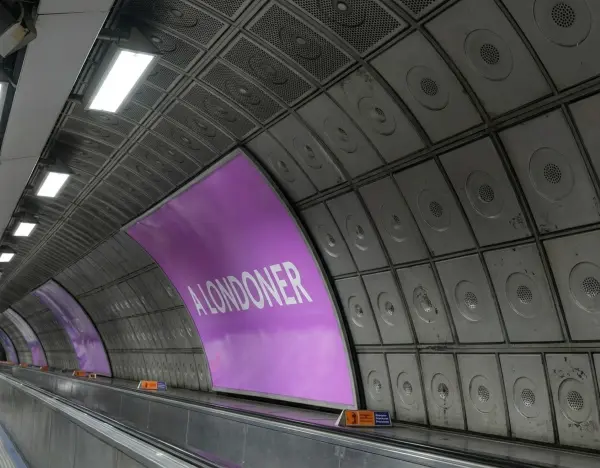
Artist Ain Bailey and vocalist Elaine Mitchener honour more than 70 closed community spaces, record shops and LGBTQIA+ venues in new Art on the Underground commission
A new sound artwork has launched at Waterloo Underground station, marking the third in a series of audio commissions exploring London’s cultural identity through Transport for London’s Art on the Underground programme.
The piece, titled Maybe It’s Because I’m A Londoner, was created by London-based composer and DJ Ain Bailey in collaboration with experimental vocalist Elaine Mitchener. It plays on loop along the moving walkway connecting the Jubilee and Northern lines until Friday 10 July 2026.
A Tribute to Disappearing Cultural Spaces
The six-and-a-half-minute audio work pays homage to more than 70 London venues that shaped Bailey’s life over five decades but are no longer open. These include Bali Hai, a nightclub significant during her teenage years, the Brixton Neighbourhood Community Association founded by her family in 1971, Soho’s Groove Records, and lesbian institution Candy Bar.
The work forms what Bailey describes as an autobiographical mapping of London, reflecting on how cultural and community spaces shape both personal identity and collective memory. This marks Bailey’s first UK public artwork.
How the Piece Was Created
Mitchener performs the libretto as a multi-layered experimental voice composition, sounding the names of each featured venue throughout the piece. The audio is interspersed with lyrics from Hubert Gregg’s wartime love song Maybe It’s Because I’m A Londoner, which Mitchener reinterprets within the new composition.
Gregg’s original lyrics are also displayed across 16 billboards positioned along the moving walkway, anchoring the audio experience within a familiar cultural reference point and grounding the artwork in a shared sense of London identity.
Part of a Wider Initiative Supporting Grassroots Venues
The commission was developed in partnership with the Mayor of London’s Culture and Community Spaces at Risk (CCSaR) programme, which has supported more than 1,500 grassroots cultural and community venues across the capital since its launch in 2024.
This is the third annual sound commission created for the Waterloo Underground walkway as part of this partnership. The first, in 2024, was created by artist Joe Namy and explored the politics of listening, music, and translation. The second, in 2025, came from Turner Prize-nominated artist Rory Pilgrim, examining connections between London and Dorset’s Isle of Portland, whose stone was historically used to build much of the capital.
What the Artists and Officials Said
Ain Bailey described the work as centred on disappearing social and cultural spaces from her own life across several decades, noting that translating these traces into sound and visual form within Waterloo station creates space for public connection and remembrance.
Justine Simons OBE, Deputy Mayor for Culture and the Creative Industries, said the artwork demonstrates the significant impact London’s cultural venues have on community life, and reaffirmed continued support for venues across the capital.
Eleanor Pinfield, Head of Art on the Underground, said the featured venues will resonate with the thousands of Londoners who pass through Waterloo station daily, evoking nostalgia against the backdrop of Gregg’s familiar tribute to the city.
Related Events
Bailey is also partnering with Iklectik, a grassroots organisation focused on experimental sound and performance, for a community listening event titled Sonic Stories, taking place on Saturday 4 July at Peckham Levels.
Why This Matters for London
London has lost a significant number of independent cultural venues, nightclubs, and community spaces over the past two decades due to rising rents, redevelopment, and changing entertainment habits. Industry data has consistently shown declines in independent music venues, LGBTQIA+ spaces, and grassroots community organisations across the capital.
Public art commissions referencing these losses serve a documentary as well as artistic function, preserving cultural memory in spaces where physical venues no longer exist. For commuters passing through one of London’s busiest interchange stations, the piece offers an unexpected moment of reflection on how the city’s social fabric has shifted over time.
More on Art at Waterloo Station
Waterloo Underground station has become a notable site for public art and cultural commissions in recent years. For more on how the station has hosted creative installations, see New Balance transforms Waterloo Underground station for Ellipse Runner launch.

